
When operators talk about reconciliation errors, they usually mean the money they did not receive or the commission that got clawed back. Those are real costs. But the reconciliation errors that cost the most in aggregate are not the ones that produce an obvious financial discrepancy. They are the small entry errors that never create a visible gap on the carrier settlement report, but that consume staff hours every time someone has to go back and verify a transaction that was recorded incorrectly at the time of sale.
This post is about that second category: the time cost of till errors that do not show up as missing money but accumulate as management overhead week after week.
How a single entry error compounds
Consider a common scenario: a staff member processes a handset sale and records the IMEI with one digit transposed. The activation goes through the carrier system under the correct IMEI (because the carrier validates against the network), but your POS record has the wrong number. At month end, when you reconcile your POS activation list against the carrier settlement export, this transaction will not match on IMEI. It is not missing from the settlement, and the payment is correct, but the automatic matching logic flags it as unmatched.
Now someone has to investigate the flag. They look at the transaction by date, by plan type, by the amount. They eventually identify it as a data entry error and manually mark it as reconciled. This takes 15 to 25 minutes for a transaction that was otherwise clean. If a store does 150 activations per month and 4 to 5 percent of them have some form of data entry discrepancy, you are looking at 6 to 7 flagged transactions, each requiring 15 to 25 minutes of resolution time. That is 90 to 175 minutes of reconciliation labor per store per month for errors that produced no actual financial gap.
Across a three-store operation, that is 4.5 to 8.75 hours per month of manager or accounting staff time on problems that existed purely because of entry errors at the point of sale.
The three most common categories of till entry errors
IMEI and ICCID transpositions. These are the most common single-character entry errors. IMEI is 15 digits, ICCID is 19 to 20 digits. Manual entry under any time pressure produces transpositions. Some POS systems validate IMEI with a Luhn check; many do not. Where validation is absent, transpositions pass through undetected until reconciliation.
Activation type misclassification. A number port-in (번호이동) recorded as a new activation (신규), or a plan-only change recorded as a device change. The carrier system records the true type; your POS records what the staff member selected. When the types do not match, the commission amounts may differ in your expected settlement calculation, creating what appears to be a financial discrepancy even when the carrier paid correctly for the actual transaction type.
Accessory and device bundle misallocation. When a device is sold with a protective case or screen protector as a bundle, the allocation of the total sale amount between device and accessory affects the accessory margin line in your daily till summary. A staff member who enters the full device price in the device field and zero in the accessory field collapses the accessory margin to zero for that transaction. This does not affect carrier settlement at all, but it makes the daily till accessory margin line unreliable as a performance metric.
Why daily reconciliation catches these faster than monthly
The case for daily till reconciliation is not primarily about catching more errors. It is about catching errors sooner, while the transacting staff member is still on shift or at least reachable the next day to clarify what happened. An IMEI transposition found the same day it was made can be corrected in minutes by the staff member who made it. The same error found three weeks later at month close requires someone to reconstruct the transaction from memory or from the customer record, which takes much longer and sometimes cannot be resolved cleanly.
Stores that do daily till reconciliation as a closing procedure consistently report shorter month-close cycles than stores that batch everything to month end. The daily check does not eliminate errors, but it prevents the accumulation of unresolved flags that makes month close a multi-day task.
We are not arguing that daily reconciliation is always feasible for every store configuration. A single-staff satellite location closing at 8pm may not have the bandwidth for a full reconciliation at close. But even a 10-minute daily check against activation count and till cash balance catches the most common discrepancies before they age.
The cash handling dimension
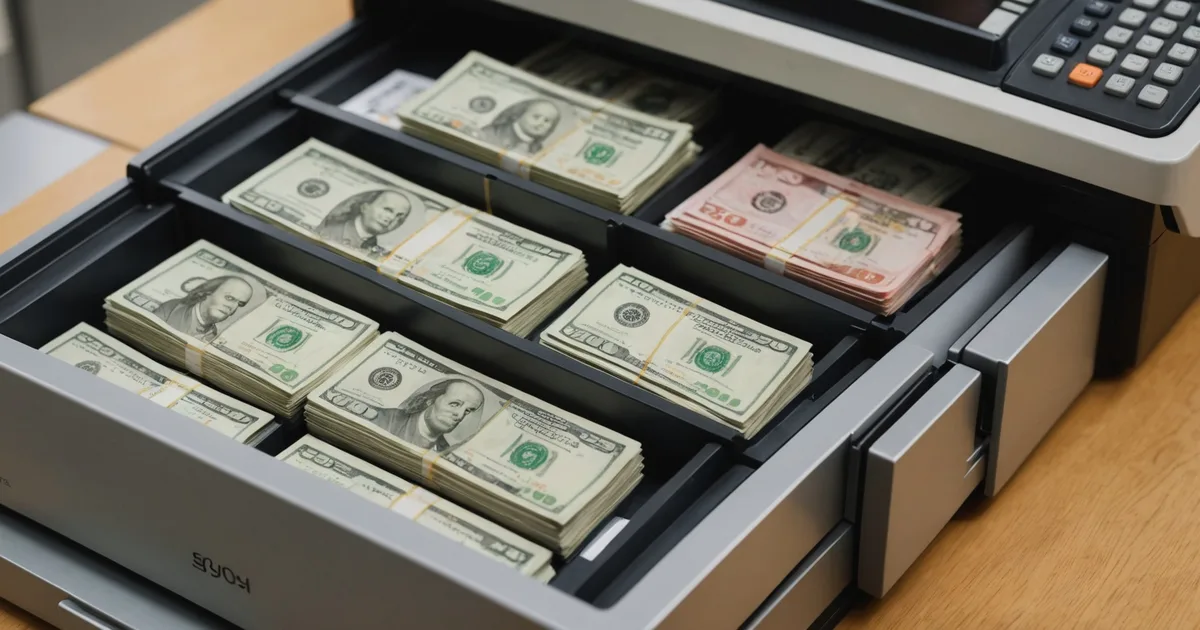
Till reconciliation in telecom retail has a cash component that is somewhat different from pure retail because device deposits, accessory cash sales, and carrier subsidy adjustments can all hit the till in the same day. A customer paying a deposit on a device order and a different customer paying cash for a screen protector show up as separate till entries. If the staff member who took the deposit used the wrong transaction type in the POS, the till balance will be short on paper even though the physical cash is correct.
This type of error is particularly slow to diagnose because the cash count matches the actual notes and coins in the drawer, but the POS shows a discrepancy. Tracking down a paper-versus-system variance requires going line by line through the day's transactions, which in a busy Saturday might mean reviewing 40 to 60 entries. This is time the manager or closing staff is spending at end of day, often under time pressure, when the error would have been obvious in 30 seconds if caught at the time of transaction.
Quantifying the total cost
Adding it up across error categories and store count: for a three-store operator, the realistic annual cost of till reconciliation errors, measured in staff time rather than financial gaps, is 100 to 200 hours of reconciliation labor. At a management staff cost of around 20,000 to 25,000 KRW per hour, that is 2,000,000 to 5,000,000 KRW per year in absorbed overhead costs. Most of this is invisible because it is distributed across dozens of small incidents rather than appearing as a single line-item expense.
The financial gaps from activation type misclassification add another layer. If 3 to 5 percent of activations have type mismatches that result in the carrier paying at the wrong commission tier, and the per-activation commission difference is 10,000 to 20,000 KRW, a 150-activation-per-month store could be leaving 45,000 to 150,000 KRW per month on the table through errors that are recoverable via the dispute process but only if they are caught and filed within the carrier's dispute window.
The first step is knowing what you have
Most operators do not have a clear picture of their till error rate because they only track errors that produce a visible financial discrepancy. The transposition errors that require manual match resolution are counted as reconciliation work, not as errors. Activation type mismatches that happen to result in the correct commission (because the commission rates for the two types are the same on that plan) are never detected at all.
Getting the true error rate visible requires comparing POS records to carrier settlement at the transaction level, not just at the total count level. Once you can see individual-transaction match rates, you can start identifying whether the errors cluster around specific staff, specific time windows, or specific transaction types, and that pattern usually points directly to where in the workflow the error is being introduced.